
-
Six partners
Led by H2FLY, the consortium covers the entire chain – from the propulsion system and the aircraft to operations at Stuttgart Airport.
-
30 months
From August 2026 to January 2029, the integration concept takes shape – from the demonstrator requirements to a clear path toward a permit to fly.
-
A real aircraft
The concept is being developed for DLR's Do328 UpLift, an existing demonstrator aircraft.
-
Funded by the German government
DIBAU is part of the German Federal Aviation Research Program LuFo Klima VII-1.

The challenge
Hydrogen-electric propulsion is considered key to zero-emission flight. However, proven integration concepts for CS-25 aircraft are still lacking. Liquid hydrogen must be safely stored, conditioned and distributed on board, the fuel cell system integrated into the structure, cooling and electrical systems, and operations aligned with the existing aircraft architecture. On the ground, airports lack refueling infrastructure, and there is no established compliance path toward a permit to fly yet.
The project goal
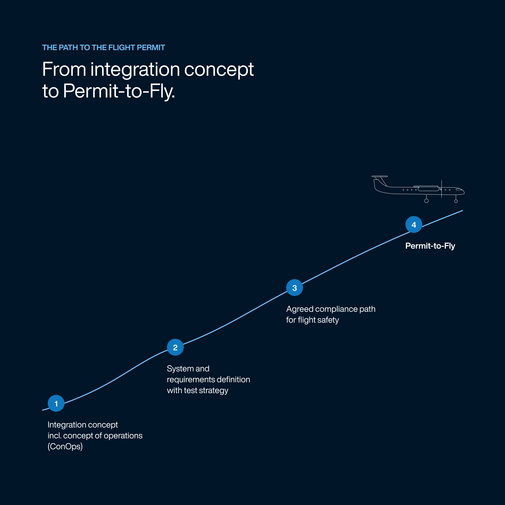
DIBAU is developing a conceptual integration guide for hydrogen-electric propulsion in the Do328 UpLift demonstrator aircraft, laying the groundwork for a permit to fly. The goal is a complete integration concept including a concept of operations (ConOps), a verifiable system and requirements definition with a test strategy, and an agreed safety-of-flight compliance path. In addition, the project covers health monitoring, a cockpit display and control concept, the connection to flight test instrumentation, and a refueling concept with a mobile liquid hydrogen ground station at the airport.
How the consortium works
The partners collaborate along the chain from aircraft to propulsion system to operations. First, they gather the requirements and boundary conditions of the demonstrator and assess integration options for the tank, fuel cell system and electrical power distribution. Building on this, they develop the system definition, interface and safety assessments, and the test strategy to demonstrate airworthiness. In parallel, the partners work out operating and emergency procedures, the cockpit interface and the instrumentation connection, and bring them together with the concept for the mobile liquid hydrogen ground station and operations at Stuttgart Airport.
Combined expertise across the consortium
-

H2FLY
Designing the hydrogen-specific systems (fuel cell, LH₂ tank and distribution, cooling), providing the safety-relevant basis for compliance demonstration, and developing the mobile LH₂ ground station
-

German Aerospace Center (DLR)
Developing the integration concept and concept of operations for the Do328 UpLift, assessing flight safety, and defining the permit-to-fly strategy in coordination with the authority
-

Diehl Aerospace
Developing propulsion health monitoring based on Integrated Modular Avionics (IMA) and a human-machine interface (HMI) for monitoring on board or from the ground
-

BTU Cottbus-Senftenberg
Selecting the electric motor and inverter with a view to certifiability, managing the thermal design of the overall system, and conducting safety analyses for the permit to fly
-

CHESCO
Creating a roadmap to the permit to fly with a verification and test strategy, analyzing the electric powertrain in detail, and assessing the required test benches
-

Flughafen Stuttgart
Analyzing requirements for airport facilities and processes, developing refueling concepts, contributing to the mobile LH₂ ground station, and assessing transferability to other airports
Funding
DIBAU is funded under the seventh national civil aviation research program Klima (LuFo Klima VII-1, KTF). Grant number: 20M2503.

The consortium
Six partners from research, the aviation industry and airport operations work together in DIBAU.





Publications from the project
Within DIBAU, the partners publish results from their respective work packages. Publications hosted by a partner link directly to the source; materials from H2FLY are available in the download section of this page.
DIBAU started in August 2026. Initial publications will be added here as they become available.
Downloads
-
DIBAU project factsheet
Key facts, objectives and consortium at a glance.
pdf 985.6 KBDownload