
-
Three partners
Led by H2FLY, the consortium brings together propulsion development, avionics and research.
-
36 months
From August 2026 to July 2029, the project builds a requirements catalog – from evaluating aircraft concepts to laying the groundwork for a demonstrator.
-
Multiple aircraft concepts
Three to five configurations are compared against certification-relevant metrics and refined step by step.
-
Funded by the German government
HERACLES is part of the German Federal Aviation Research Program LuFo Klima VII-1.
The challenge
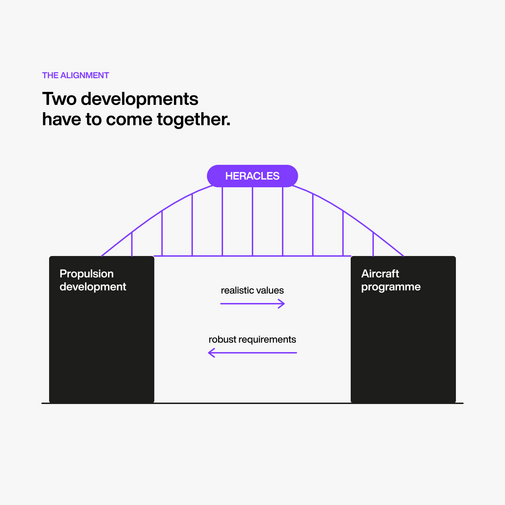
For hydrogen-electric regional aircraft to reach the market, two developments need to come together: aircraft design needs realistic performance data for future liquid hydrogen and fuel cell systems, while propulsion development needs reliable requirements from the aircraft. Aligning the two is key to evaluating integration concepts and steering development priorities and technology maturity.
The project goal
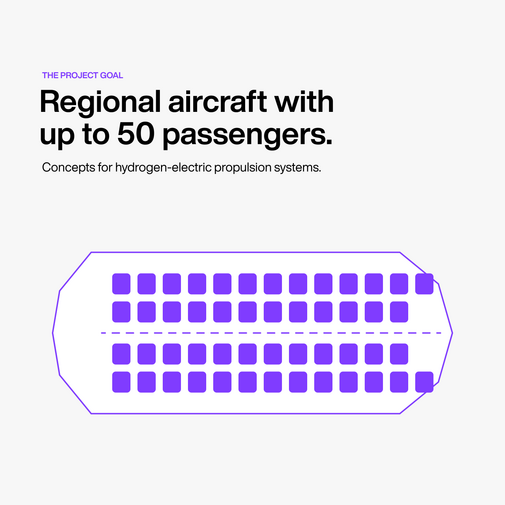
HERACLES develops integration and aircraft concepts for regional aircraft with up to 50 passengers, focusing on how hydrogen-electric propulsion – including its systems and controls – can be made ready for market entry. To this end, several aircraft configurations are evaluated against certification-relevant metrics (CS-25), and a validated, quantified requirements catalog is derived, with target values for fuel cell system power density and the voltage level of electrical power distribution, among others. Comparing these against technology readiness levels (TRL) shows where further development is needed. The results lay the foundation for further aircraft and propulsion development and for a demonstrator.
How the consortium works
The partners take an iterative approach: they design aircraft concepts, match them against the performance, mass and safety requirements of the hydrogen-electric powertrain, and refine them progressively. Market analyses and annual workshops assess how mature the available technologies are and how much development potential they offer. In addition, the partners develop concepts for controlling and monitoring the propulsion system based on Integrated Modular Avionics (IMA). The findings feed into the planning of a demonstrator
Combined expertise across the consortium
-

H2FLY
Supporting the aircraft and integration concepts with the boundary conditions of liquid hydrogen fuel cell propulsion, assessing the concepts from a technology perspective, including existing technology gaps, and deriving requirements for future system and component development
-

German Aerospace Center (DLR)
Leading the aircraft design for hydrogen-electric regional aircraft with up to 50 passengers, developing demonstrator concepts – including for the Do328 UpLift – and building a virtual iron bird in the UpLift avionics lab to test the control of multiple fuel cell stacks
-

Diehl Aerospace
Assessing the feasibility of highly reliable control systems based on Integrated Modular Avionics (IMA) for megawatt-class fuel cell propulsion, using its own control computers as real hardware in the hybrid validation environment, and advancing its technology for configuring avionics platforms
Funding
HERACLES is funded under the seventh national civil aviation research program Klima (LuFo Klima VII-1, KTF). Grant number: 20M2414.

The consortium
Three partners from research and the aviation industry work together in HERACLES.


Publications from the project
Within HERACLES, the partners publish results from their respective work packages. Publications hosted by a partner link directly to the source; materials from H2FLY are available in the download section of this page.
HERACLES started in August 2026. Initial publications will be added here as they become available.
Downloads
-
HERACLES project factsheet
Key facts, objectives and consortium at a glance.
pdf 612.4 KBDownload