
-
Four partners
Led by H2FLY, the consortium brings together research and the aviation industry – from system development to power electronics.
-
30 months
From June 2026 to November 2028, the system takes shape – from component design to performance verification on the test bench.
-
Down to component level
Compressor, humidification, cooling and fluid management are redesigned and optimized for weight.
-
Funded by the German government
H2F-175 evo is part of the German Federal Aviation Research Program LuFo Klima VII-1.

The challenge
For hydrogen-electric propulsion to be used in aircraft, fuel cell systems need to become significantly lighter. Today's systems are too heavy for aviation, which limits payload and range. Small adjustments are not enough – what's needed are fundamental advances all the way to individual components. Operation at cruise altitude adds another challenge: how PEM fuel cells behave at low ambient pressure has received little study so far. This limits power, efficiency and service life in flight.
The project goal
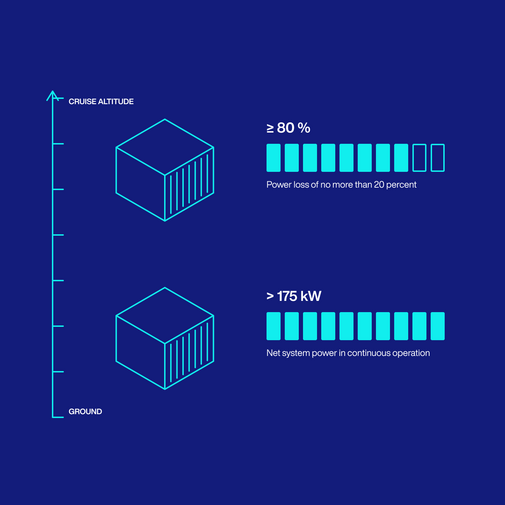
H2F-175 evo develops a highly integrated, weight-optimized fuel cell system for aviation with a net system power of more than 175 kW in continuous operation. To achieve this, the modular architecture and subsystems are refined, and the operating window is expanded in terms of pressure, current density and temperature. The second goal is operation at high altitudes: power loss at low air pressure is to be limited to a maximum of 20 percent. Two further building blocks complement the system: a compact, scalable high-power switching technology and an enhanced version of Integrated Modular Avionics (IMA).
How the consortium works
First, the partners derive the requirements and redesign key components of the fuel cell system, including the compressor, humidification, cooling and fluid management. Preliminary tests on single cells, short stacks and an existing system provide the data for system control and for operating strategies at low pressure. The new components are verified under aviation-relevant conditions and then integrated into a complete system whose performance is demonstrated on the test bench. In parallel, the power switches are selected, connected to the IMA control system and validated in test series.
Combined expertise across the consortium
-

H2FLY
Developing the highly integrated fuel cell system with weight-optimized components for the anode, cathode and thermal subsystems and new control concepts, as well as verification testing, including at low ambient pressure
-

German Aerospace Center (DLR)
Investigating fuel cell operation under altitude conditions in the altitude chamber and on the UpLift altitude test rig, developing strategies to mitigate degradation at altitude, alternative humidification concepts and catalytic oxidation of the purge gas for improved hydrogen safety
-

Diehl Aerospace
Developing an IMA-controlled, compact and scalable technology for safely switching system power: selecting suitable power switches, building a functional prototype and testing it with H2FLY on the fuel cell test infrastructure
-

Fraunhofer IISB
Developing lightweight power electronics for fuel cell systems with high power density: an aviation-grade solid-state high-voltage DC circuit breaker and a bidirectional DC/DC converter between high and low voltage
Funding
H2F-175 evo is funded under the seventh national civil aviation research program Klima (LuFo Klima VII-1, KTF). Grant number: 20M2424.

The consortium
Four partners from research and the aviation industry work together in H2F-175 evo.




Publications from the project
Within H2F-175 evo, the partners publish results from their respective work packages. Publications hosted by a partner link directly to the source; materials from H2FLY are available in the download section of this page.
H2F-175 evo started in June 2026. Initial publications will be added here as they become available.
Downloads
-
H2F-175 evo project factsheet
Key facts, objectives and consortium at a glance.
pdf 1.2 MBDownload